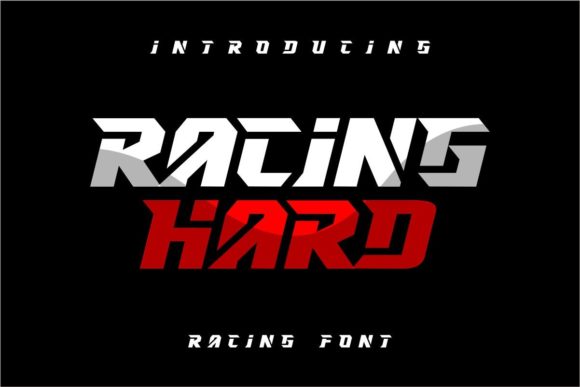
Racing Hard: Why This Bold Typeface Demands Respect and Strategy
You have likely scrolled past a poster, a YouTube thumbnail, or a sneaker brand’s Instagram post where the typography hit you like a physical object. The letters are thick, aggressive, and impossible to ignore. That is the signature of Racing Hard, a display font designed to convey strength, confidence, and dynamic energy. While it might seem like a simple aesthetic choice, selecting this typeface for your projects involves more than just clicking "download." It requires an understanding of visual hierarchy, contrast, and context.
Many designers, marketers, and business owners treat fonts as mere decoration. They grab the first bold option they find and apply it without considering how it interacts with other elements. When used correctly, Racing Hard can add tons of trendy character to your designs, elevating a flat layout into something that feels premium and urgent. However, when misused, it can clutter your message, reduce readability, and make your brand look amateurish. Let’s look at why this font is so popular, where people typically go wrong, and how to ensure you get the most out of its powerful presence.
Understanding the Visual Weight of Racing Hard
To use Racing Hard effectively, you must first understand what it actually does. As a bold and thick lettered display font, it carries significant visual weight. In design theory, weight refers to the thickness of the strokes that make up the characters. Heavy weights pull the eye immediately. This makes Racing Hard an excellent tool for headlines, logos, and call-to-action buttons where you need to stop the scroll.
The font reads as strong and confident because of its geometric precision and lack of delicate serifs or thin lines. It doesn’t whisper; it shouts. For entrepreneurs and freelancers looking to establish authority quickly, this font provides an instant sense of reliability and power. However, this same characteristic is also its biggest pitfall. Because it demands attention, it leaves little room for subtlety. If your entire design is loud, nothing stands out. You end up with noise rather than communication.
The Mistake of Over-Saturation
A common error among beginners is using Racing Hard for body text or long paragraphs. Even if the font size is small, the thickness of the letters causes them to bleed into one another, creating a muddy gray block that strains the reader’s eyes. This directly affects usability and satisfaction. If a customer cannot read your pricing details or your product description because the font is too heavy, they will leave. Period.
Correction: Reserve Racing Hard strictly for short phrases, titles, and keywords. Pair it with a clean, lightweight sans-serif or a highly legible serif for supporting text. The contrast between the heavy display font and the light body copy creates a professional rhythm that guides the reader’s eye naturally through your content.
Context Matters: Where Racing Hard Fits (and Where It Doesn’t)
Another frequent misunderstanding is assuming that any project can benefit from a bold, dynamic font. Racing Hard thrives in industries that value speed, strength, competition, or modernity. Think automotive, fitness, gaming, tech startups, or urban fashion brands. In these contexts, the font aligns perfectly with the brand’s personality.
However, applying this same font to a boutique law firm, a serene yoga studio, or a luxury wedding invitation often results in a jarring disconnect. The font’s aggressive nature can undermine the trust or calmness those industries rely on. When evaluating whether to buy or download Racing Hard, ask yourself: Does this font match the emotional tone of my message?
- Good Fit: A gym logo, a concert flyer, a tech product launch banner.
- Poor Fit: A legal contract header, a children’s book interior, a minimalist skincare label.
By matching the font’s energy to your industry, you avoid confusing your audience. Consistency in tone builds credibility. If your visuals scream "extreme action" but your service is "gentle counseling," you create cognitive dissonance that hurts your conversion rates.
Technical Considerations: Licensing and File Formats
Before you start designing, there are practical hurdles regarding licensing and file formats that many overlook. Racing Hard is a commercial-grade display font. Unlike free web fonts, it usually requires a license that corresponds to your usage—whether that is personal, desktop, or extended web use.
Common Pitfalls:
- Assuming Free Availability: Many sites offer "free downloads" that are outdated versions, watermarked, or malicious. Always purchase from reputable foundries to ensure you get the full character set and proper support.
- Ignoring Web Fonts: If you plan to use Racing Hard on a website, standard desktop licenses often do not cover embedding the font in CSS. You may need to purchase a separate web font license, which can be significantly more expensive. Failing to do this puts you at risk of legal action.
- File Format Confusion: Ensure you are downloading the correct format for your software. Most modern design tools prefer .OTF (OpenType) or .TTF (TrueType). If you are working with vector graphics in Illustrator, OTF is generally safer for scalability.
Checking these details upfront saves time and money. It also ensures that your final output looks crisp on all devices. A poorly rendered font file can make even the best design look cheap.
Maximizing Impact Through Spacing and Color
Even with the right font and license, execution is key. Racing Hard has unique spacing characteristics due to its thickness. Designers often underestimate the amount of white space needed around bold letters. If you squeeze Racing Hard too tightly, the letters lose their individual identity and become a solid bar of ink.
Better Approaches:
- Increase Tracking: Slightly increasing the letter spacing (tracking) can enhance readability and give the text a more premium, airy feel. Experiment with adding 20–50 units of tracking to see how it changes the mood.
- Contrast Colors: Because the font is visually heavy, it works best against high-contrast backgrounds. White text on black, or neon yellow on dark gray, makes the font pop. Avoid low-contrast combinations like light gray on white, which will disappear entirely.
- Mix Weights: If the font family offers lighter weights, use them for secondary information. Using only the boldest weight for everything creates a monotonous experience that fatigues the viewer.
Evaluating Your Choice Before Committing
Before you finalize your design or invest in a license, take a step back. Print out your headline in Racing Hard at actual size. View it on different screens. Ask a colleague to look at it without explaining what it says. If they instantly grasp the tone and can read the main message, you have succeeded. If they squint or feel overwhelmed, dial it back.
Racing Hard is a powerful tool in the designer’s arsenal. It adds tons of trendy character and projects a strong, confident image. But like any tool, its effectiveness depends on the skill of the user. By avoiding common mistakes related to overuse, poor pairing, and licensing oversights, you can harness its energy to create designs that not only look great but also communicate clearly and drive results. Whether you are a blogger updating your site headers or a small business owner rebranding your logo, treating the font with respect will pay dividends in professionalism and impact.