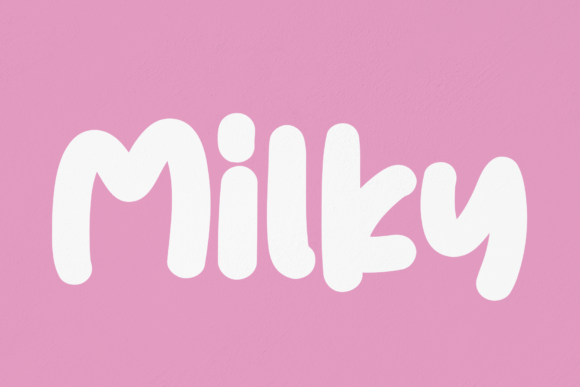
Milky Font Evaluation
In the landscape of digital typography, selecting the right typeface is rarely just about aesthetics; it is a strategic decision that influences readability, brand perception, and user engagement. Among the myriad of options available to designers, Milky has emerged as a distinct choice for projects requiring a balance of casual warmth and structural clarity. This evaluation explores the characteristics of Milky, a simple, thick-lettered, and casual display font, to help designers determine whether it aligns with their specific project requirements.
Understanding the Design Philosophy of Milky
To evaluate Milky effectively, one must first understand its visual language. The font is categorized as a display font, which typically means it is designed to be used at larger sizes rather than for extensive body text. Its defining characteristic is its thickness; the letters are bold and substantial, giving them a physical presence on the page or screen. This weight contributes to its "simple" nature, stripping away unnecessary serifs or complex ligatures in favor of clean, solid forms.
The term "casual" in the context of Milky does not imply sloppiness. Instead, it suggests an approachable, friendly, and informal tone. The letterforms often feature rounded edges or slight irregularities that mimic hand-drawn styles without sacrificing legibility. This combination of thick strokes and casual proportions creates a visual identity that is both fun and authoritative enough to grab attention. It is adaptable by design, meaning it can shift from a playful headline to a sophisticated logo mark depending on the spacing and color choices made by the designer.
Why Designers Consider Milky
When researching fonts, professionals often look for versatility. Milky offers this through its ability to convey emotion without relying on imagery. There are several key reasons why a designer might include Milky in their shortlist:
- Immediate Visual Impact: Due to its thick lettering, Milky stands out in crowded environments. In social media graphics or banner ads where users scroll quickly, a heavy, friendly font can halt the eye more effectively than delicate serif faces.
- Brand Personality Alignment: For brands aiming to appear accessible, youthful, or community-focused, Milky provides an instant personality cue. It avoids the coldness of geometric sans-serifs and the formality of traditional serifs.
- Cross-Platform Consistency: As a display font, Milky tends to render consistently across various devices. Its simplicity reduces the risk of rendering artifacts on lower-resolution screens, ensuring the "fun and friendly" touch remains intact whether viewed on a mobile phone or a large desktop monitor.
- Adaptability in Layouts: The font’s neutral yet expressive nature allows it to pair well with a wide variety of other typefaces. It can serve as the primary voice in a poster while leaving room for simpler, thinner fonts for detailed information.
Benefits and Practical Applications
The primary benefit of using Milky lies in its emotional resonance. Typography is a non-verbal communication tool, and Milky speaks a dialect of warmth and approachability. This makes it particularly effective in sectors where trust and friendliness are paramount.
Marketing and Advertising: In promotional materials, headlines need to communicate value instantly. Milky’s thick strokes ensure high visibility, while its casual style invites interaction. It is ideal for sale banners, event posters, and limited-time offer graphics.
Branding and Identity: Startups and small businesses often seek logos that feel human-centric. Milky can be customized—through kerning adjustments or color changes—to create unique wordmarks that feel bespoke rather than generic. It works well for cafes, boutiques, creative agencies, and lifestyle brands.
Digital Content: In the age of content creation, thumbnails and headers require strong typographic hierarchy. Milky provides a robust structure for titles, making them easy to read even when overlaid on busy background images.
Tradeoffs and Limitations
No typeface is a universal solution, and understanding the limitations of Milky is crucial for making an informed decision. Because it is a display font, its utility is inherently restricted.
Readability in Body Text: Using Milky for paragraphs or long-form content is generally discouraged. The thick letterforms can cause visual fatigue, and the casual nature may undermine the seriousness required for instructional or legal text. It lacks the subtle nuances needed for comfortable reading over extended periods.
Niche Professionalism: While Milky is friendly, it may not suit industries that prioritize tradition, luxury, or strict professionalism. A law firm, a financial institution, or a high-end fashion house might find Milky too informal. In these contexts, the "fun" aspect could detract from the perceived authority of the brand.
Overuse Risks: Because Milky is highly adaptable and visually striking, there is a temptation to use it excessively. Over-reliance on a single display font can lead to a monotonous design system. Designers must exercise restraint, using Milky as an accent rather than the sole typographic voice.
Decision-Making Insights: When to Choose Milky
Evaluating whether Milky is the right choice requires a clear assessment of your project goals. Consider the following scenarios:
- Target Audience Demographics: If your audience skews younger or responds well to informal, engaging communication, Milky is a strong candidate. It bridges the gap between professional design and casual conversation.
- Context of Use: Is the font being used for headlines, logos, or UI elements? If yes, Milky excels. If it is intended for terms of service, manuals, or dense articles, you should look elsewhere.
- Brand Tone: Does your brand want to be seen as a friend or an expert? Milky positions the brand as a friend. If the goal is to establish expertise through gravitas, a serif or a refined sans-serif might be more appropriate.
Alternatives to Consider
If Milky does not fully meet your needs, several alternatives exist within the same category of casual display fonts. Pacifico offers a more script-like, handwritten feel, which may be better for creative or artistic projects but less structured than Milky. Baloo is another option that shares Milky’s roundness and friendliness but features slightly more variation in stroke width, offering a different rhythmic quality. For a cleaner, more modern take on casual, Nunito provides a rounded sans-serif that is versatile enough for both display and body text, addressing one of Milky’s main limitations.
Conclusion
Milky is a specialized tool in the designer’s toolkit. It is not a workhorse font meant for endless pages of text, but rather a spotlight font designed to illuminate key messages with warmth and clarity. Its thick, casual letterforms make it an excellent choice for brands seeking to appear approachable and for designs requiring immediate visual impact. By understanding its strengths in display contexts and its limitations in body copy, designers can leverage Milky to create projects that are not only visually appealing but also strategically aligned with their communication goals. Ultimately, the decision to use Milky should rest on how well its friendly, sturdy character matches the voice you wish your project to convey.